i attended their annual conference this weekend in Savannah, Georgia, and, just as i expected, i emerged totally smitten. i have never emerged smitten from a history conference-- and i've been to MANY of those! but AMIA is a really awesome group of folks doing pretty fantastic work, and also i have long had a fetish for moving image archiving.
highlights:
well, this is really a lowlight: my flight got cancelled on thursday night, so i was rebooked on a flight out on friday morning, and then there was more mishigos friday morning and anyway long and short, i missed all of thursday and all of friday's panels. alas! but i did get to go to the Archival Screenings on Friday night, which was fantastic. Among other things, there i got to see recently restored versions of
--an episode of "Firing Ling from 1968, featuring a priceless one-on-one interview in which William F. Buckley attempts to interview Alan Ginsberg. At one point, in response to a question that Buckley asks, Alan Ginsberg takes out his harmonium and sings "hare krishna" to a nervous, smiley, totally freaked out Buckley. omg.
--a 16mm film called "Roaches" or something like that, from the 1970s that's in the NYPL archival collections, in which three New Yorkers talk about and demonstrate their strategies for killing the roaches that live in their kitchens. hilarious and cathartic.
--a segment from WGTV, the University of Georgia's TV station, from 1965, featuring a performance/presentation by the folksinger Jimmy Driftwood (who i'd never heard of before but of whom i am now a very avid fan). highlights: Jimmy playing the "mouth harp," a giant bow-and-arrow type bow that gets held up to your mouth as you play it; shots of delighted UGA students seated in a large lecture hall; and shots of the ginormous television camera shooting from behind Jimmy.)
--an experimental film commissioned by Sears in 1968, meant to advertise Sears clothing. Psychadelic colors, fluid dancing, multiple images-- as if you were doing acid and then rushing off to buy clothes as Sears.
this is getting really long so i'll just note 2 digital resources i found out about at the conference, for now, and write about some of the other things later:
--i found about about this wonderful digital archive that's been produced by a collaborative team at the University of Georgia, called the Civil Rights Digital Library. It features a lot of material including moving images, available online, from local Civil Rights struggles around Georgia. Not the standard kind wherein Dr. King stands behind a podium. Unusual stuff. Plus lesson ideas and contextual information. A REALLY RICH and wonderful resource-- for teachers, for instance. Check it out here.
--i have now viewed "A Fair(y) Use Tale"-- and i encourage you to view it too. it explains Fair Use and launches a critique of US copyright law via, exclusively, clips from Walt Disney films. Voila:
Monday, November 17, 2008

Monday, November 10, 2008
this thing that's bothering me
i danced and sang and shouted in the streets in brooklyn on tuesday night and hugged total strangers and felt elation and incredulous joy. i knew it wouldn't last, but i also knew it felt right to celebrate wildly.
and now, almost a week later, i'm starting to feel annoyed by this one thing the commentators have been saying a LOT: that this couldn't happen in any other country on earth.
see, for instance, this otherwise genius day-after-the-election conversation between jon stewart and chris wallace.
and notice: it wasn't just chris wallace saying it: jon stewart agrees.
i'm not going to go point by point and country by country and talk about why this is incorrect, i'm just going to say two words, in capital letters: SOUTH AFRICA. a country that did something far more unprecedented, quite a number of years ago. HOW COME NO ONE IS SAYING THAT. i hate this crappy american exceptionalism. its harshing my mellow, majorly.
and now, almost a week later, i'm starting to feel annoyed by this one thing the commentators have been saying a LOT: that this couldn't happen in any other country on earth.
see, for instance, this otherwise genius day-after-the-election conversation between jon stewart and chris wallace.
and notice: it wasn't just chris wallace saying it: jon stewart agrees.
i'm not going to go point by point and country by country and talk about why this is incorrect, i'm just going to say two words, in capital letters: SOUTH AFRICA. a country that did something far more unprecedented, quite a number of years ago. HOW COME NO ONE IS SAYING THAT. i hate this crappy american exceptionalism. its harshing my mellow, majorly.
Tuesday, October 28, 2008
sir, no sir
i've just been watching the trailer for "sir, no sir"-- a film about the resistance movement inside the military that grew up during the vietnam war. its not a new film-- it was produced a few years ago. but its still important (and its not a bore to watch!) and, because i'm thinking a lot these days about the "lessons of vietnam," i'm going to link to it here.
oh and Lisa Guido reminded me that i should mention contemporary parallels (instead of just suggesting them): see, for instance, the film project Soldiers Speak Out, here.
critically important. now that we have a 2nd winter soldier, i want a 2nd coffeehouse movement!
oh and Lisa Guido reminded me that i should mention contemporary parallels (instead of just suggesting them): see, for instance, the film project Soldiers Speak Out, here.
critically important. now that we have a 2nd winter soldier, i want a 2nd coffeehouse movement!
Thursday, October 16, 2008
homeschooling
the thing is, why do all articles about homeschooling have to focus on either extremely wealthy white new yorkers or christian fundamentalists? the more time i spend inside public schools and studying the policy debates and curriculum debates that orbit around public schooling, the more i long for an alternative that might let ALL young people (not just the fantastically rich ones) develop their capacities as creative and curious humans. (as opposed to as future cogs-in-the-machine.) homeschooling offers so many totally fundamentally DIFFERENT ideas about what education could be, that in theory i think it could be useful as a counterpoint to the standard elements of the current conversation about public schooling-- except that its so completely privatized and not-publicly minded, that its insights are barely transferable. alas.
which brings me to this: there's one of the latter kind of article --the kind that focuses on wealthy new yorkers-- in the New York Times today. its problematic. but like many problematic things, its also thought-provoking. so i'm going to link to it, here.
remind me that soon i have to ask my friend, killer sideburns, to tell me more about her experience with the un-schooling movement.
today's NYT article provoked me to remember (as if i was having trouble remembering; actually, i'm not--i'm having trouble forgetting) just how fervently i wish we would just throw over the whole system and start again-- with art at the center of our educational efforts.
and while we're on THAT subject, here's another site about arts education that caught my eye recently: its called Art Education 2.0.
which brings me to this: there's one of the latter kind of article --the kind that focuses on wealthy new yorkers-- in the New York Times today. its problematic. but like many problematic things, its also thought-provoking. so i'm going to link to it, here.
remind me that soon i have to ask my friend, killer sideburns, to tell me more about her experience with the un-schooling movement.
today's NYT article provoked me to remember (as if i was having trouble remembering; actually, i'm not--i'm having trouble forgetting) just how fervently i wish we would just throw over the whole system and start again-- with art at the center of our educational efforts.
and while we're on THAT subject, here's another site about arts education that caught my eye recently: its called Art Education 2.0.
Tuesday, October 14, 2008
angel island hit by wildfires

i got a note from a reader about this. apparently they saved the historic buildings but the island was really hit hard and it could have been very bad. See the SF Gate article here.
Monday, October 13, 2008
a plug for me

i'm really excited to have an article in the latest edition of the Radical History Review-- its a special issue entitled "history and critical pedagogies: transforming consciousness, classrooms, communities." a very solid collection of writings on what i think is a very important topic. my essay is certainly not the only reason to check the volume out-- there are a number of really smart pieces therein. but if you do get a chance to read my essay, i'd love to hear what you think. its entitled "theater of the assessed: drama-based pedagogies in the history classroom."
you can read the full table of contents here.
it doesn't solve our financial crisis or get rid of NCLB or make the political craziness stop, but-- its there. what to do.
Wednesday, October 08, 2008
angel island immigration center

I am researching Angel Island Immigration Station for another chapter of this book i'm writing, and just found the very interesting site of a photographer who apparently took pictures of the historic site. the historic site appears to use mannequins, and reconstructions of the detention station, and his photos have an eerie awkward quality to them that is pretty affecting. (the image at the top of this post is one of them.) his name is Thomas Chang.
Check some of them out here. Another batch is here.
there are also tons of maps floating around on the internets of angel island, many of which highlight its attractiveness as a tourist site-- apparently you can go biking and boating near the the old detention center. See this one for instance.
woah. what to say? except that oh, history sometimes feels really really troubling.
Saturday, October 04, 2008

the lawsuits begin
the first of what will undoubtedly be many lawsuits against the St. Paul cops for their behavior during this year's RNC has been filed. by a guy who was hit in the stomach with a "high velocity projectile" (a tear gas cannister? a stun grenade?)and then falsely arrested on september 4. he seeks $250,000 in damages.
see the pioneer press's report about this lawsuit here.
i'm working on writing a piece about my experience at the RNC; keep your eyes peeled. it may be a while before i finally post it. but perhaps in the meanwhile i'll start posting links to news reports and stuff as they develop.
see the pioneer press's report about this lawsuit here.
i'm working on writing a piece about my experience at the RNC; keep your eyes peeled. it may be a while before i finally post it. but perhaps in the meanwhile i'll start posting links to news reports and stuff as they develop.
Friday, October 03, 2008
General McClellan responds to Sarah Palin.
this is history as dumb post-Veep-debate blogosphere scorn. but it is also just really funny.
the joke, in case you're not paying as much attention to this political circus as some people are, is that Palin referred to the General leading US troops in Afghanistan right now as General McClellan instead of General McKiernan. General McClellan was actually a Civil War General. And the kids over at Pinko magazine have spoofed this. Check it out here.
the joke, in case you're not paying as much attention to this political circus as some people are, is that Palin referred to the General leading US troops in Afghanistan right now as General McClellan instead of General McKiernan. General McClellan was actually a Civil War General. And the kids over at Pinko magazine have spoofed this. Check it out here.
Thursday, September 25, 2008
local hudson valley history
one of my students, gregory bailey, has been doing some interesting work on local history in the hudson valley. on which more later. see his site here, for some examples.
Saturday, September 06, 2008
"how to tell people they sound racist"
awesome ideas told against the backdrop of a phat beat.
This video promises to start interesting discussions among young people and middle aged people and old people alike. check it out here, and also, right here:
This video promises to start interesting discussions among young people and middle aged people and old people alike. check it out here, and also, right here:
Wednesday, August 27, 2008
things that haunt


i'm watching Hillary Clinton's speech at the DNC in Denver on the web-- its the MSNBC version. (just as I watched Michelle Obama's and Ted Kennedy's speeches yesterday morning.) and i just can't help but feel haunted-- and i'm saying this _really_, not just because i'm supposed to write about the presence of the past in this blog--i just can't help feeling haunted by the past. i've been thinking about the uncanny way this whole contest between Hillary and Obama echos and parallels the kinds of debates that framed the 19th century contest between white women and African American men, who were both seeking suffrage. but the video of speeches from the convention is also notable because the camerapeople keep, when they pan to the audience, featuring black delegates. which, ok, its happened before, but its so striking how frequently they choose to focus in on an African American during these pauses. which could have a million reasons-- look! even the black delegates are supporting hillary's speech!, for instance-- but it also just makes so visible the fact that: there really hasn't been this much MAINSTREAM attention and energy around African American participation in US electoral politics since Reconstruction. the 1870s --that is, in those few years before the brutal hand of white supremacy clamped down very hard again on African Americans in this country. sure, there was the years when JFK invited MLK to the white house, but that was quite different, i'd argue. Fannie Lou Hamer didn't just want access to the DNC-- she wanted it on HER OWN pretty freaking radical terms.
i'm not a fan of electoral politics, but i am a fan of reading pageantry for political and historical and cultural information. and this is pretty much a bonanza for that sort of thing. and messed up: its been 135 years since there's really been any strong mainstream attention paid to African American participation in US electoral politics.
in other news from the political conventions, the Denver police --who are patrolling the protests around the Pepsi center in downtown Denver-- AREN'T WEARING ANY IDENTIFICATION. which is pretty much illegal. and certainly a dangerous sign. (anyone who thinks the dems are going to change the direction that policing and surveillance is going in this country is a bit deluded, i'd say.)
and meanwhile, in Minneapolis, some video activists had their gear confiscated in a 2 am raid this week. under the guise of homeland security. because laptops and cameras are dangerous weapons. well, ok, they are-- but they're legal. oy.
Tuesday, August 26, 2008
what i think about when i think about blogging from upstate ny

(above, a picture of the view from the bridge part of the rail-train in rosendale. even better in person: woah.)
1)the rail-trail that goes from rosendale to new paltz. its a relic of the era when rosendale was a boomtown--one that was busy mining limestone from the rocks above the river to make the cement that fueled the nyc building boom of the late 19th and early 20th centuries. i haven't done enough research on this yet (and i do mean YET) but there is some spotty info about the history of cement mining and the origins of the rail trail online. Here, for instance is some info about the history of the rail trail in specific; there's a general timeline of rosendale cement history here; more info, from the website Traditional Masonry, here; and the general wikipedia entry about rosendale is here.
2)historical markers. i'm interested to see what is marked and what is not. sojourner truth, who was born in ulster county, has only one "marker" that i've noticed yet-- the SUNY new paltz library is named after her. on the other hand, i've seen two korean war memorials and several monuments to american revolution battles. its not surprising, but i am still interested in it.
3)SUNY new paltz was originally a normal school-- that is a school that exclusively trained teachers. the department i'm in (secondary education) is usually located in the Old Main building-- at the moment, we've been relocated so that major renovations can be done on Old Main. This is causing and has caused quite a bit of consternation, but is generally looked upon as a welcome event.
ok, thats it for now.
Wednesday, August 20, 2008
more resources from the internets
this one is a collaboration between Sam Wineburg (author of Historical Thinking and Other Unnatural Acts) and The Center for New Media and History at George Mason (creators of the History Matters website). woah. i mean, you know?
its called Historical Thinking Matters.
check it out here.
its called Historical Thinking Matters.
check it out here.
Friday, August 15, 2008
a good website for teaching the slave trade
I just heard about this, I think its new-- and seems to have been spearheaded by some historians at Emory University in Atlanta. Check it out here.
Thursday, July 24, 2008
oh, legal history
Searching around today for some scholarship on the relationship between the 17th century Virginia slave codes and the historical invention of the idea of racial difference in the US, i discovered yet another blog that i'm excited about. (I appear to have entered a moment of renewed interest in the peripheral non-electoral blogosphere. blame the zodiac, if you can.) Its the Legal History Blog--which appears to be a project of the wonderful legal historian Mary Dudziak (author of the Very Important book Cold War Civil Rights: Race and the Image of American Democracy, among other things). I am supposed to be hard at work on chapter 8 of my book History as Image, Image as History: Visual Knowledge and History in the Classroom, so i don't have time to explore it as thoroughly as i'd like, but its possible i'm in love with a blog.
or maybe its just lust.
Anyhow, check it out at http://legalhistoryblog.blogspot.com/
or maybe its just lust.
Anyhow, check it out at http://legalhistoryblog.blogspot.com/
Wednesday, July 23, 2008
re: ongoing projects
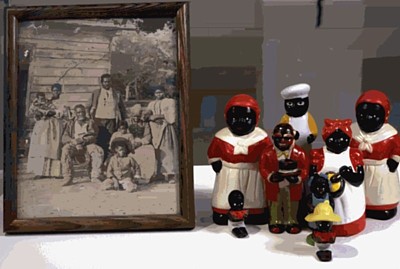
(the above image is a piece by the artist Fred Wilson, entitled "mine/yours.")
i'm in the middle of trying to make major headway on two book projects that are under contract and due in the next few months. both are collaborations with multiple other people, which is great but also hard. collaboration is hard! also writing books is hard. and both are also attempts to bring strong but inaccessible historical thinking into contact with strong ideas about pedagogy and classroom practice.
the one i'm deepest in the middle of at this precise moment is a book about the idea and practice of using contemporary art to teach history in the secondary social studies classroom-- a topic that, remarkably, hasn't really been explored in depth anywhere else to date. its a great project, and i've been working with my collaborators on it for years, and we have a good structure, but i'm coming up against what is often a problem in this kind of cross-disciplinary ginormous type of endeavor: how to boil things down? how to pick a central historical question and idea from the fifteen or so that seem important in any given chapter, and how to make sure its THE one that best suits the artwork and the pedagogical purpose? its really challenging. also: how to keep the ideas at a high level without losing the readers, without writing incomprehensibly? how to address both complicated historical questions and the practical and pedagogical concerns of classroom teachers? these are questions that i am contemplating.
and in specific, i'm contemplating the question of how to do this in a chapter that's specifically about the history of race, and through the lenses of slavery & abolition, and immigration. there are obvious ways to do this, and that's why we (I) put them all together in a chapter on the history of race, but its also SO MUCH MATERIAL to choose from-- in addition to the other concerns i mentioned above. plus we're keeping the whole project primary document-based...and etc.
on a positive note: i'm very excited about the project, and this chapter in particular is really getting me jazzed-- especially the task of publishing and thinking about structures for talking about the primary documents i'm working with, some of which i don't think have been published in teacher-oriented texts ever before, and some of which are gaining new meaning in light of the works of contemporary art with which we're pairing them. for instance the image at the top of this post, by Fred Wilson, is, i think, just so provocative, and really invites a very distinct conversation about racial identity and the way that US Americans remember slavery than you could get from a historical monograph. Of these two representations of a family of enslaved people, Wilson's piece asks, which is "yours?" which is "mine?" more importantly, it seems he's making a statement about the way that slavery is officially remembered in the US, versus, perhaps, how African Americans remember/understand it.
Its not just Fred Wilson, either. There are quite a number of genius contemporary artists grappling with important historical questions. and these artists offer, on the one hand, fresh kinds of critical historical analysis. although most historians wouldn't recognize them as such, these sorts of artworks really are also works of historical analysis (in visual form) in and of themselves. also many of the pieces that we've found open up unusual doorways for thinking about classroom activities and models of learning and writing and thinking. its exciting to think about putting this material (and guides for how to think about and use it in a classroom context) into the hands of educators.
alright, back to work... more soon...
Tuesday, July 22, 2008
two good education-related blogs
in june, i went to a radical teacher education conference at the center for anti-oppressive education at the university of illinois-chicago. two of the most exciting things i encountered there were
a)mica pollock's new book and project, _everyday anti-racism_, which offers what i think is an interesting model for use in professional development contexts and teacher-led critical inquiry groups: it offers short question-generating texts to read, and a protocol for discussion that focuses on both long term and short term approaches to political and educational classroom challenges. pollock has also started a blog, connected to this project, to encourage converssation about how to teach and talk about and teach against racism in k-12 contexts. check it out at www.schoolracetalk.org
and
b)a range of projects that therese quinn, an old friend of an old friend of mine who teaches arts ed stuff at the school of the art institute of chicago, has been organizing. these include TAME (teachers against militarized education), and a bunch of anti-homophobia in k-12 and teacher education projects. she also has a nice blog at http://therese-othereye.blogspot.com/
a)mica pollock's new book and project, _everyday anti-racism_, which offers what i think is an interesting model for use in professional development contexts and teacher-led critical inquiry groups: it offers short question-generating texts to read, and a protocol for discussion that focuses on both long term and short term approaches to political and educational classroom challenges. pollock has also started a blog, connected to this project, to encourage converssation about how to teach and talk about and teach against racism in k-12 contexts. check it out at www.schoolracetalk.org
and
b)a range of projects that therese quinn, an old friend of an old friend of mine who teaches arts ed stuff at the school of the art institute of chicago, has been organizing. these include TAME (teachers against militarized education), and a bunch of anti-homophobia in k-12 and teacher education projects. she also has a nice blog at http://therese-othereye.blogspot.com/
Subscribe to:
Posts (Atom)


 Posts
Posts

